Resources & Support
New here? Start with our guide to eldest daughter syndrome.
Challenging the Crown
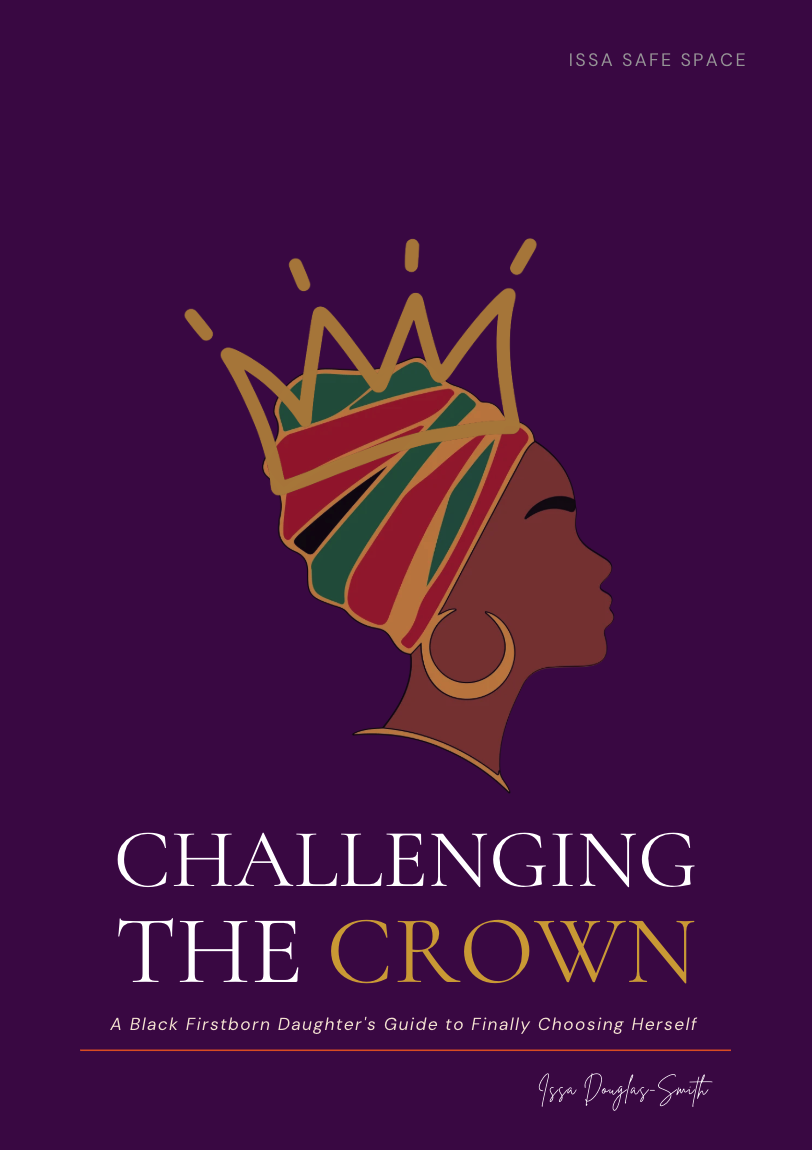
You were handed a crown before you were old enough to agree to it. Challenging the Crown is for the Black firstborn daughter who is done performing strength she never chose. Blending neuroscience, trauma-informed coaching, and big sister honesty, this is the guide that finally gives you permission to put the crown down.
US$22.00 including tax and shipping
What readers are saying
★★★★★
"It's not just a book; it's a mirror showing us that we can be powerful without being exhausted."
★★★★★
"I strongly connected with the expectations placed on firstborn daughters. A truly eye-opening and validating experience."
★★★★★
"I think having this info brings awareness to a lot of tired women - so thank you for sharing this with all us firstborn daughters out there."
★★★★★
"There is something in there that any soul-searching woman could use..."
The Crown Glossary
Words for the things you've always felt but were never given language for.
1. The CrownWhat You Were Handed
- The Crown
The Strong Black Woman identity, handed to you like a royal inheritance before you were old enough to choose it. The love behind it is real. It is also heavy, it marks you out, and it's hard to put down without people noticing.
Sounds like: “You're so strong. I don't know how you do it.”
- Strong Black Woman Narrative
The cultural story that Black women are built for endurance: we carry, we cope, we don't get tired, and needing things is a luxury we can't afford. It is praised in every direction, which is why it's so hard to question.
Sounds like: “Black women don't break.”
- Challenging the Crown
This doesn't mean throwing the crown away. It means looking honestly at what it has cost you to wear it, and deciding, maybe for the first time, whether you need to keep it on.
- Firstborn Daughter
The eldest girl in a family, who is often handed responsibility, emotional labour and leadership long before she's ready. It is a role as much as a birth position.
Sounds like: “You're the eldest, you should know better.”
- Eldest Daughter Syndrome
A popular (not clinical) term for the patterns many eldest daughters share: over-responsibility, people-pleasing, guilt around rest and difficulty receiving care. At Issa Safe Space we call this the firstborn script.
- Number Ones
What I call the women this work is for: the firstborn daughters, the first ones, the ones everyone calls.
2. The ScriptThe Rules You Never Chose
- The Script
The invisible set of instructions you absorbed from family, culture and birth order before you could question them. It kept you safe as a child. As an adult, it can quietly become a cage.
Sounds like: “If I keep everyone happy, things will be okay.”
- Rewriting Your Script
The practice of noticing the old lines, deciding which still serve you, and choosing new ones. You don't fix yourself. You take your pen back.
- Parentification
When a child is given emotional or practical responsibilities that belong to an adult: being a parent's confidant, keeping the peace, raising siblings. It can come from love and still cost you something.
(Research: Gregory J. Jurkovic, Lost Childhoods, 1997)
Sounds like: “You can handle it.”
- Deputy Adult / Deputy Parent
The role a parentified daughter often plays, sometimes into adulthood: the one who handles things, makes the calls and is the family's first responder.
- Black Tax
The financial and emotional cost of being the one who “made it,” and therefore the one who is expected to give back. That can mean sending money home, supporting relatives, or being on call from thousands of miles away.
Sounds like: “You're doing well now, so you can help.”
- Diaspora Household
A Caribbean, West African, East African or other diaspora home, where the firstborn role often carries material obligations as well as emotional ones.
3. The BodyWhere the Script Lives
- Nervous System
Your body's safety system. In homes where safety depended on reading the room, it learned to stay on high alert and never fully switched off.
- Hypervigilance
Constantly scanning your environment for signs of tension or danger, often before you've even taken your coat off.
Sounds like: “What mood is she in today?”
- Chronically Activated Stress Response
When your body stays in survival mode even though your life is objectively fine. This is why rest feels unsafe and calm feels suspicious.
- Wired but Exhausted
Being tired to your bones but unable to switch off. It often comes from a disrupted cortisol rhythm, where the stress hormone that should drop at night stays up.
Sounds like: 2am replaying conversations and planning tomorrow.
- The Four Trauma Responses
Your body's automatic survival strategies:
- Fight: defensive, especially when your competence is questioned.
- Flight: overworking and over-scheduling, because stopping means feeling.
- Freeze: shutting down or going numb after giving too much.
- Fawn: people-pleasing to stay safe.
- Fawn Response
The firstborn daughter's default: keeping everyone comfortable so that you stay safe. It feels like kindness, but it is kindness deployed as protection.
(Coined by Pete Walker, Complex PTSD, 2013)
Sounds like: Apologising before you've even said what you need.
- Rest and Receive
Our name for your parasympathetic nervous system, usually called “rest and digest.” This is the state your body needs in order to heal, and the state firstborn daughters rarely allow themselves.
- Grounding
Simple body-based practices (5-4-3-2-1, box breathing, self-soothing touch) that bring you back to the present when your mind is spiralling.
- The Pause
One breath between the trigger and your response. You don't have to change your answer yet. That breath is where your choice lives.
4. The PatternsHow the Crown Shows Up
- Performed Strength
Looking strong because your worth was tied to how capable you appeared. Everyone sees it as confidence. It isn't.
Sounds like: “I'm fine.”
- Performed Competence
Achieving to feel worthy, never admitting struggle, and needing to be seen as capable. It drains you.
- Authentic Confidence
Confidence that doesn't need to perform. It can say “I don't know,” “I need help” and “I got that wrong” without the floor falling away.
- Overfunctioning
Doing more than your share by taking on responsibilities that belong to other people and holding together things that were never yours to hold.
Sounds like: “It's quicker if I just do it.”
- Giving from Depletion vs Giving from Fullness
Giving because you're afraid of being seen as selfish, versus giving because you have something left to give. The love is the same, but the cost is not.
- Guilt as Conditioning
The guilt you feel when you set a limit is not your conscience. It is decades of being taught that your worth lives in your availability.
- Boundaries
Not walls, but doors. They're calm, clear limits that protect your energy and keep resentment out of relationships.
Sounds like: “I love you, and my answer is still no.”
- Outgrowing People
Realising that some relationships only worked when you were smaller. Their discomfort with your growth is theirs to manage.
5. The RewriteComing Home to Yourself
- Limiting Belief
A story about yourself that feels like fact but was handed to you.
- Surface Belief vs Root Belief
Surface beliefs are what you hear yourself say (“I can't say no to my family”). Root beliefs are the deeper story feeding them (“I am only valuable when I'm useful”). Cut the surface and it grows back, so go for the root.
- Spot, Reframe, Replace
A three-step process for rewriting beliefs: notice the belief, question it (“Is this fact or fear? Whose voice is this?”), then choose a truer one.
- Rooted Affirmation
An affirmation your nervous system can actually believe. Start small and start true.
Sounds like: “I am learning to treat myself with kindness,” rather than “I love myself fully.”
- Rest as a Radical Act
For Black firstborn daughters, rest is not only a biological need. It's a refusal of the story that says we don't get tired. You don't earn rest. You're allowed it because you exist.
- Unlived Grief
Grief not only for what happened, but for what didn't: the soft, silly, curious childhood you deserved. It can show up as tears, but also as irritation, resentment or anger that has been pressed down too long.
- Releasing the Role
Giving yourself permission to stop being the glue, the example and the responsible one, and to simply be a person.
- Safe Space Rituals
Small daily practices (a morning check-in, a midday reset, an evening reflection) that teach your body you're safe to be who you are.
- The Unbecoming
The eight-stage framework behind all of this work. It takes you from who you were taught to be back to who you actually are. Each stage is called a Breath.
The Bookcase
A growing shelf of work for firstborn daughters ready to lead their own lives.
The Unbecoming

A 12-Week transformation for firstborn daughters
Move from recognising your patterns to practicing something different
This is the full work. Not a course. Not a content library. A structured supported journey through the unbecoming, designed to take you from over functioning, over-giving and running on empty, to leading your own life from a place of genuine authority and peace.